Upcoming Event: Oden Institute & Dept. of Statistics and Data Sciences
Learning Dynamics with Limited Data
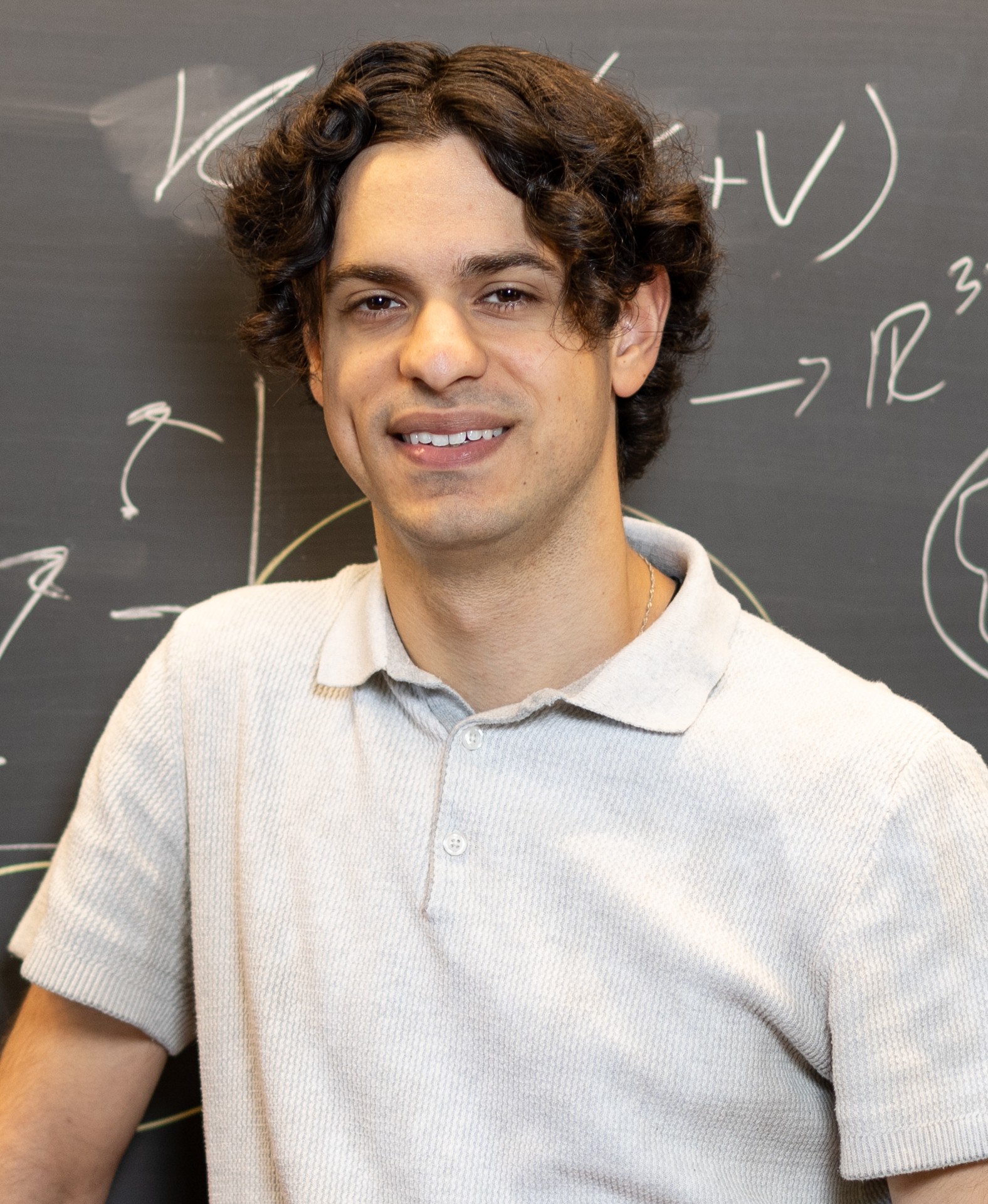
George Stepaniants, Postdoctoral Fellow, California Institute of Technology
3:30 – 5PM
Tuesday Jan 27, 2026
Abstract
Over the past two decades, dynamical modeling has drawn on machine learning, statistics, and optimization, broadening our ability to learn models directly from data. Researchers are increasingly turning to data-driven approaches to model complex systems in mechanics, biology, economics, and many other areas of science and engineering where mechanistic models are not known or need to be enhanced. Despite recent progress, model inference methods still struggle to learn and generalize in data-limited regimes, hampering our ability to discover governing laws from experiments, produce accurate forecasts, and control systems. This challenge is compounded by the absence of statistical and analytical theory linking model design to the quality and structure of data.
Here, we develop novel data-driven frameworks for the inference of dynamical laws and forecasting of spatiotemporal processes in regimes where data are unlabeled, scarce, or expensive to generate. These frameworks use modern developments in optimal transportation, model optimization, and neural operator design to solve open problems in trajectory tracking, inference of biochemical dynamics, and simulation of material deformations. Our methods are guided by rigorous statistical and analytical approximation results. We discuss the future deployment of these frameworks in the modeling of material, fluid, and weather dynamics, and our broader vision for the theory and practice of scientific machine learning in data-limited regimes.
Biography
George Stepaniants is an NSF MSPRF postdoctoral fellow at the California Institute of Technology in the Department of Computing and Mathematical Sciences working with Andrew Stuart. His research centers on developing physically faithful models in scientific and engineering problems when data are collected from disparate sources, sample-limited and noisy, or partially observed. He studies the use of optimal transport methods, neural operators, autoregressive models, and a variety of machine learning algorithms in these contexts, backed by rigorous statistical and analytical theory.
He received his PhD in Mathematics and Statistics from the Massachusetts Institute of Technology in 2024 in the Department of Mathematics, co-advised by Philippe Rigollet and Jörn Dunkel and funded by the NSF GRFP and MIT Presidential Fellowship. He was also part of the Interdisciplinary Doctoral Program in Statistics through the Institute for Data, Systems, and Society. He graduated in 2019 from the University of Washington with a Bachelor of Science in Mathematics and Computer Science, working in the Department of Applied Mathematics with Nathan Kutz.
Event information
Tuesday Jan 27, 2026